As any review should be, I promise not to spoil anything about the book in question…

A co-worker invited me into a book club and I graciously accepted another excuse to read books, especially since my main source of literature topics involve post-apocalyptic tales with vampires, magic and talking cats.
After reading this novel by Colson Whitehead, I know why I tend to stray away from historical fiction. Well, technically American historical fiction because a story like this only leads to ask questions to which I already know the answer, an answer that’s backed by decades upon decades of history.
The history of the Underground Railroad is taught to elementary school children, like my youngest daughter, as a way that slaves escaped the captivity of the South and headed North to ‘freedom’. That understanding of this moment of American history is correct on the surface, but ignores the underlying facts that would paint the North just as guilty as the South when it comes to race relations.
 Before I continue, allow me to note that my current vision is blurred by reading Eight Years We Were In Power: An American Tragedy, a collection of essays by Ta-Nehisi Coates that uses research and quotations to illustrate that the same sentiments that led to slavery have been prevalent in this country since and have never left; whether it was the formation of the Klu Klux Klan to stop free blacks from voting and owning guns to the ‘War on Drugs’ and how the prison system altered from reforming inmates to ensuring ways to keep the numbers rising…
I moved from that book to The Underground Railroad and while it’s a novel, meaning fictional, it’s hard not picturing some of the atrocities that take place having a basis in reality.
There are statues of James Marion Sims in Pennsylvania, New York City and South Carolina. Sims is consider a pioneer in the field of surgery and the “father of modern gynecology“. His contributions include fertility treatments, abdominal and vaginal surgery and cancer care.
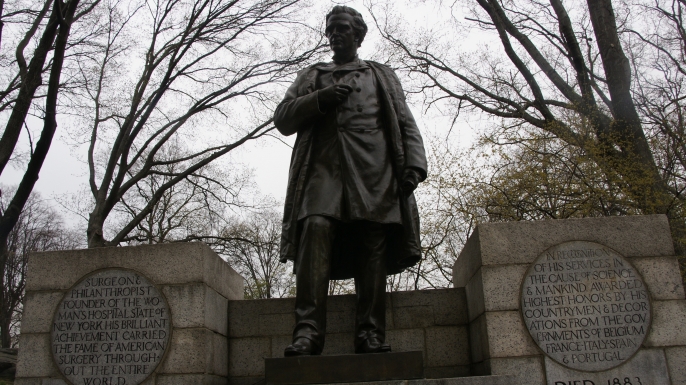
But the second paragraph of his bibliography starts with the fact he practiced his techniques and examinations on black female slaves without anesthesia. How much should that take away from the thousands of lives likely saved because of his discoveries?
I don’t have an answer to that question or some of the statements made by Arnold Ridgeway, a slave catcher that pursues Cora, the protagonist of the story. He makes a living returning ‘property’, regardless where it has fled to. He believes in ‘The American Imperative’, which is to kill, steal, enslave, and destroy.
He believes that if God didn’t want blacks to be slaves, he wouldn’t have allowed them to be taken from their native Africa and shipped across the ocean. That if the Native Americans were supposed to inhabit this land, they would have been smart enough to know there would be no compromise with the Colonizers. That any treaties or documents they presented would only favor the White Man.
But Whitehead does such a great job crafting Ridgeway’s character that, while you’re not rooting for him, you understand his motives. I don’t know if I can say the same thing about Cora, but part of that is knowledge of the future and the fact that without her indecision, the novel would likely be a lot different.
Needless to say, Core runs from her Georgia plantation, Ridgeway searches for her and she’s able to witness the sins of Sims and other good Southern citizens protecting their heritage and God-given rights.
Sadly as I read, the underlying knowledge that had any slave made it North, they were likely to run into similar treatment by those sanctified citizens above the Mason-Dixon Line. I’ll admit it darkened my reading of The Underground Railroad, but I was still invested in Cora’s next step and her final outcome. It’s a great novel, one worth it so long as you don’t hang yourself up in all the injustice that happens within.
 Martin Kester - My Digital World