
As any review should be, I promise not to spoil anything about the book in question…
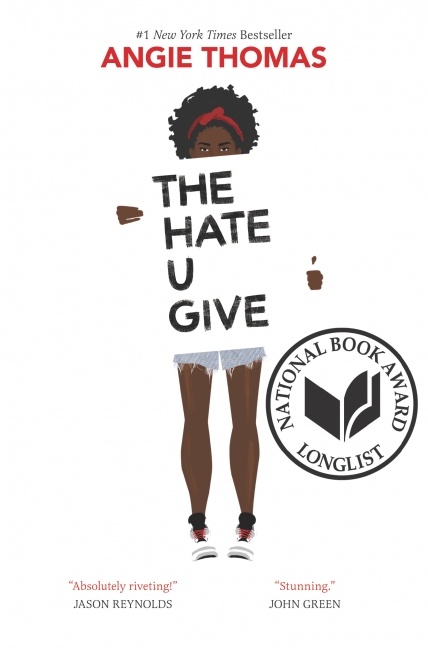
It was a book cover on notice long before I opened it. Long before I entered the world of a black high school junior living in two worlds.
It reminded me of my childhood, spent interacting with people of all races; feeling accepted by all and yet separate in the same. The mix of my hometown allowed me to walk one way from my home and hand with, shoot hoops with and live among ‘black people’. If I went another way, I was doing the same with ‘white people’.
The quotes around each are because sometimes ‘black’ meant first-generation Haitians, a Colombian family around the corner or authentic stereotypical black people who didn’t know their roots, only where their grandparents came from. In that same light, ‘white’ could mean non-practicing Jews, an Italian family with open doors or a Polish kid who liked The Beastie Boys and Gang Star.
 For Star in The Hate U Give, the difference was fundamentally more basic. Her family moved from a project apartment complex to a home, but remained inside the ‘black’ town of Garden Heights. Witnessing an atrocity forces her parents to send her to Williamson, a private prep school 45 minutes away and even farther when speaking socioeconomically.
Needless to say, another tragedy shakes Star’s world and the bulk of the book deals with the aftereffects and actions both forced and created because of the two worlds she lives in. She is forced to reflect on her actions existing in both worlds, how she changes for one or the other and eventually questioning why.
The questions posed with the book come from an authentic voice and language that led me to believe it wasn’t a YA title. but as I think back, the only things pushing it away from that classification is the foul language used by all characters, similar to the language used by those of us in the real world including the President.
In the real world, I would never expect a family member to die. But it seems to a staple of most YA features, whether they be in book form or on the screen. Sadly, I fully expected something similar to happen in The Hate U Give, but was shocked and pleased with the conclusion of the central issue.
However, that was resolved with pages left and the one fault I found with this book happens in the final pages. The close is as saccharine-rich as anything I’ve read, made even sweeter by the fact actions/events are continuously piled on.
But just because that authentic voice sounds true to ‘The Streets’ doesn’t mean the book failed with its story book ending. Yes, it was the stereotypical YA ending, but it was certainly what was deserved, even if it’s something that is normally denied.

Because at the end of the day, this is a novel that focuses on a black youth dealing with the police and race relations. With so many live-action versions of the tale happening every day to thousands who don’t get their story immortalized on page, it was happy to see that character be happy for once.
I was happy to hear that Amandla Stenbert was chosen to play Star. Her light-skinned complexion was the reason she chose to drop out of auditions for Shuri in ‘Black Panther’ and don’t match the image on the book cover, but the role requires a skilled actress that will need to carry the weight of the film, both on and off screen.
At its core, this is still a book/film about a black family; something that has always been a hard sell in America. For every ‘Hidden Figures’ and ‘The Cosby Show’, there’s hundreds of great concepts and ideas that didn’t reach the light of day due to the darkness surrounding the main cast.
With only 14 credits on IMDB, Stenbert has already stole scenes in The Hunger Games and carried Everything, Everything to gross ticket sales three times that of its budget. It’s not much, but it’s more than asking an unknown to do something similar.
Isn’t it enough that we’re already dealing with a book from an unknown asked to fictionalize a situation that the ‘mainstream media’ portrays one side of, those in ‘the streets’ portray another and few who don’t live within it truly understand. That any of this is being brought into the light for all to see is way more important that the hue of the lead character.
I’m happy to have read this important book before it goes to film and can only hope a similar fervor is felt to support it when it is released. It’s a story that should be shared with as many people as possible, if only so they can experience and see the other side of the street.
 Martin Kester - My Digital World